Wedding guest list: the half you manage, the half that escapes you
Wedding guest list: the logistical half you manage and the human half that escapes you. Save-the-dates, RSVPs, plus-ones, dietary needs, and the real point about guests no tool can fix.
You think a guest list is a spreadsheet of names to tick off. You open it on a Sunday, you add the family, the friends, the colleagues, and you tell yourself the hardest part is done.
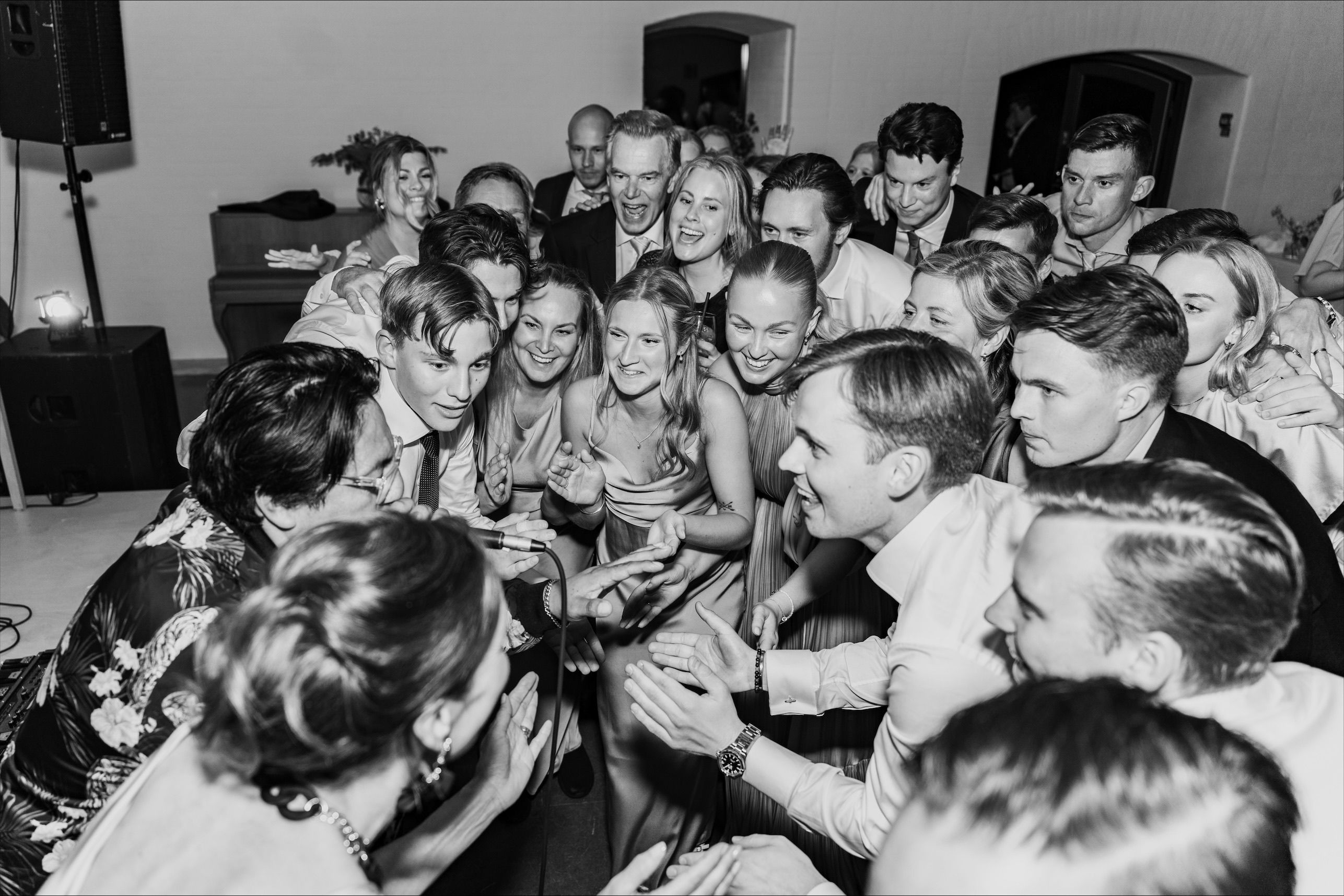
In reality, a guest list is two very different things. There's the half you manage: the replies coming in, the plus-ones, the dietary requirements, the final headcount your caterer is waiting for. And there's the half that escapes you: the people. The ones who don't reply, the ones who turn up with an unexpected plus-one, the ones who film the ceremony even at the cost of stepping in front of the videographer as you walk in. The first half, a tool can carry for you. The second, no one can, and that's exactly as it should be.
This article is about both. Because couples are heavily prepared for the logistics, and almost never for the human side.
The exact headcount doesn't exist
First thing to accept: you'll never know in advance exactly how many people will actually be there on the day.
The numbers give you a baseline. According to RSVPify data, about 83% of invited guests confirm and 17% decline. The Knot suggests roughly the same rule on the planner side: expect around 20% to decline. In France, for a local wedding, the typical figure is more like 85–90% confirmed. So out of 100 invites, expect some not to come.
The problem is that these averages say nothing about your wedding. On the forums you'll read couples who had 2 declines out of 180 invites, and others where half couldn't make it. The decline rate depends on so many things (your relationship with the guests, distance, season, whether it's a weekday or a long weekend) that no formula really predicts it.
Hence the trap behind the advice you see everywhere: "invite 20% more, people will decline anyway." That works as long as people actually decline at the expected rate. But if your decline rate turns out low, you end up with a venue too small and a caterer that can't keep up. The healthier rule is the opposite: only invite people you could genuinely host if everyone said yes. And plan for the fact that a few may simply turn up without having replied, because that happens too.
For a destination wedding or one with lots of guests who need to travel, the decline rate goes up (often 25 to 40%), but those who confirm almost always come: they paid for a flight, booked time off, reserved a hotel. We'll come back to this, because it changes the whole calendar.
A guest list isn't a list
The word "list" is misleading. A list is fixed. Your guest list moves up to the last day.
A cousin who decides last minute they can come after all. A friend who cancels at D-7. A plus-one you weren't expecting. A dietary requirement you discover three weeks before. A family asking to add a child. Each of these on its own seems trivial. Put together, they turn your starting spreadsheet into something that looks nothing like the file you opened.
Above all, the guest count doesn't live alone in a corner. It's the figure that drives almost everything else. The budget first: caterers charge per head, so every guest more or less shifts the bill directly (the catering line averages around €110 per guest in mainland France). The seating plan next: you can't place anyone until you know who's really coming. And the venue logistics: the chairs, the place settings, the favours, all of it follows.
That's why the guest list is the first domino. As long as it's moving, everything that depends on it is moving too. Stabilising it as early as possible is how you free yourself for the rest.
The timeline people underestimate
Guest management isn't an event. It's a timeline. And it starts much earlier than most people think.
The save-the-date (6 to 12 months out). The most overlooked reflex, and the most important when some of your guests are coming from far away. The save-the-date is not the invitation. Its only job is to give people enough notice to book time off work, find a flight that isn't ruinously expensive, and arrange a place to stay. For a local wedding, it's not essential. But the moment you have family or friends who need to fly or drive several hours, a save-the-date 6 to 12 months out makes a real difference to who can come. An invitation sent 8 weeks before is too late for these guests: leave is already booked, or flights have doubled in price.
The invitation (about 12 to 8 weeks out). This is the formal document, with the venue, the time, and the request for a reply. For a local wedding, this lead time is enough.
The RSVP deadline (about 4 weeks out). This is the date you're asking for a reply by. It's not decorative: it's what gives you time to chase non-responders, finalise the seating plan, and give the caterer the final numbers.
Chasing replies (after the deadline, not before). A small point of etiquette many couples ignore: chasing someone before the deadline you set yourself is poor form. You gave a date, let it pass. Once it has, you're perfectly within your rights to nudge the silent ones. The line that works without making anyone feel guilty: "Our caterer needs final numbers this week, could you confirm?"
Final numbers to the caterer. The endpoint. The whole timeline exists to hit it.
Why don't people reply, by the way? Rarely out of bad faith. Most of the time they're overwhelmed, they forgot, or they're waiting to find out if they can get the time off. It's human. Which doesn't make it any more comfortable for you: in the meantime, you're the one recounting, chasing, and not knowing where you stand.
That's where the spreadsheet shows its limits. The invitations go out, then the replies scatter: a text, a Sunday call, a message read and never answered, a confirmation slipped in over dinner. You log all of it by hand in a file only you keep up to date. As a couple, you never have the same version in your heads. And the closer the date gets, the fuzzier the count becomes — exactly when it should be sharp.
The half no tool handles: the people
Here's the part nobody really talks about, and that's a shame, because it's the one that surprises couples the most.
A couple shared a sharp piece of advice on a wedding forum after getting married: the most useful thing they'd learned was not to expect guests to know the etiquette. Not out of cynicism. Just because, in real life, people are less attentive and less up to date on what's done or not done than you'd assume. Especially if you've spent months reading forums where everyone knows exactly how others "should" behave.
Concretely, here's what happens to many couples, and it's well documented by etiquette specialists:
Some guests won't reply, or will reply poorly, despite reminders.
Some will ask you questions whose answer is already on your invitation or wedding website.
Someone will ask for a plus-one that wasn't planned, or simply turn up with one.
Someone will arrive late to the ceremony, or call you ten minutes before to let you know.
Despite an explicit unplugged-ceremony request, someone will film everything anyway, sometimes with their phone propped up against a centrepiece.
Someone will ask how much the wedding cost.
Someone may critique the food to your face.
If you asked for "no gifts," you'll receive gifts.
The lesson from that couple, and it's exactly the right mindset: hold the line on what genuinely matters to you, but don't let small breaches of etiquette ruin your day. Most people aren't acting in bad faith. Some are from a different generation, a different culture, or haven't been to a wedding in fifteen years. And a few, who do know the codes perfectly well, simply feel close enough to you to assume the rule doesn't apply to them.
How do you decide what deserves a hard line versus what to let go? A simple question helps: does this threaten the schedule or the comfort of the majority? A guest bringing an unannounced plus-one when the venue is full, yes, that needs handling in advance. An uncle asking how much you spent, no, that's not worth a minute of your energy on the day.
One thing that defuses a lot of situations: ask a trusted person (a maid of honour, a level-headed family member) to pass on your expectations in advance to those who need to hear them. It's often more effective, and less confrontational, than doing it yourself.
Our story
For our wedding in Reunion Island, we were around 150 guests. A handful were coming from mainland France, which meant a long, expensive flight and time off booked months in advance. With hindsight, that's exactly the case where a save-the-date would have made a real difference, and we didn't think of it in time. Some of our loved ones could come, others couldn't, and it's the kind of regret that doesn't quite fade.
On the replies, we set our RSVP deadline at D-30. Past that, we made our decisions without waiting for the stragglers. If someone confirmed afterwards, we'd fit them in, but we no longer rebuilt everything around them.
A particularity of Reunion Island: traditionally, the parents do the inviting. My parents and my in-laws came with us when we visited close family. For the more distant relatives, we couldn't make the round of every home, and the parents took over. For friends, there's less of a code, it's down to you. Visiting people in person has a hidden upside: you take the temperature. You quickly get a sense of who'll want to come and who won't. That kind of information isn't written anywhere, but it helps you anticipate the seating plan.
The flip side, when some invitations are carried by the parents and others by you, is that you have to centralise the information from several sources. Everything ran through WhatsApp, across several conversations, and we were glad the history stays accessible: we reopened it a ridiculous number of times to double-check who had confirmed what.
On the surprise front, we got off lightly. A family member announced a plus-one we barely knew. Others let us know that if their children weren't invited, they wouldn't come. More recently, at my sister's wedding, one guest refused to sit at her assigned table because she didn't know the other guests well enough. These things happen. The rule is always the same: you take it, you adapt, you don't make it a bigger deal than it is.
What you actually need to collect
Beyond the yes or no, a guest's reply should tell you three things, and those are the ones that matter for what follows.
The plus-one. Who gets to bring someone, and who comes alone? It's the most sensitive point. Many guests assume they can bring someone even when it wasn't stated. Be clear on the invitation about who is invited, by name. And don't hesitate to repeat it if you hand the invitation over in person. It saves you the awkward last-minute request and the maths blowing up a week before.
The children. How many, what age? Many venues and caterers charge children differently from adults, and beyond five or six kids a dedicated table or a play corner changes everything. Knowing it early is the difference between organising it and being stuck with it.
The dietary requirements. Vegetarian, gluten-free, halal, allergies. This isn't a detail: it's what your caterer needs to know so guests aren't left in front of a plate they can't eat. And it's typically the information that arrives in fragments ("oh by the way, aunt so-and-so is vegetarian now") if you don't ask for it explicitly in the RSVP.
These three pieces of information, properly collected when guests reply, are exactly what feeds the budget (how many covers, at what price) and the seating plan (who sits where, with which menu). Gathered piecemeal later, they become a source of stress. Asked for upfront, they become a simple field to fill in.
How ÆTHERNA handles this
ÆTHERNA's digital RSVP starts from a simple idea: your guests reply online, and the list updates for both of you at the same time. No card to re-key by hand, no text message to log into a spreadsheet, no "who has the latest version." When a reply comes in, you both see it, and the headcount updates on its own.
What we really wanted, though, is for you to decide what to collect. The form fields are customisable: attendance, plus-one, children, dietary needs, and anything else you care about for your own wedding — the song they want to hear on the dance floor, how they're getting there, whether they need accommodation, whatever you like. Most RSVP tools impose fixed fields. We start from the idea that every wedding is different, and you shouldn't have to bend to someone else's form.
And because everything is centralised, those replies feed directly into the seating plan and each guest profile: you don't enter your guests a second time to place them, they're already there.
For chasing non-responders, you can nudge the silent ones manually from within the tool, by filtering the guests who haven't replied yet. Automated reminders are on our roadmap.
Another honest note: sending save-the-dates isn't part of ÆTHERNA yet either. It's also on the roadmap, but for now, that's a step you handle on your side.
And for the rest, the real rest: no tool will make your cousin reply faster, or change how people behave on the day. ÆTHERNA takes the logistics off your plate, the part that weighs on one person's shoulders and eats up an extraordinary amount of time. What it leaves you with is the energy for the human side. Which is, exactly, the only side that deserves your attention.
FAQ
How many guests should I invite to be sure of the right number?
There's no "safe" number. Plan for 15 to 20% declines on average, but don't treat it as a given: the rate is unpredictable. The prudent rule is to only invite people you could host if 100% of them said yes, and to plan for a few unannounced arrivals on top.
When should I send wedding invitations?
About 8 weeks out for a local wedding, with a reply date set 4 weeks before the day. If some of your guests are coming from far away, add a save-the-date 6 to 12 months in advance, so they have time to sort out time off, travel and accommodation.
What do I do about guests who haven't replied?
Wait for the deadline you set to pass (chasing before is bad form). Then contact the silent ones directly, anchored in a concrete reason: the caterer needs final numbers. If they still don't reply, you're entitled to count them as absent, while keeping in mind that some may still show up.
Do I have to give everyone a plus-one?
No, and it isn't rude. Name who's invited on the invitation itself. As a rule, you offer a plus-one to guests in established couples, and let solo guests sit at tables where they'll feel comfortable rather than imposing a default plus-one on them. The key is being clear from the start to avoid the last-minute ask.
How should I handle dietary requirements and allergies?
Ask explicitly in the RSVP, not after. Late-collected, this is the information that puts the caterer in a corner and stresses everyone out. Captured when guests reply, it becomes a simple field to forward.
Is a spreadsheet enough to manage guests?
For a small list managed by one person, it can do. The spreadsheet breaks down when two of you need to track the same replies in real time, when answers come in via five different channels, and when that data then has to feed the budget and the seating plan without re-entry. That's where a dedicated tool saves time and sanity.
Try ÆTHERNA to manage your RSVPs as a couple, in real time: it's free up to 50 guests, no time limit, no credit card. aetherna.fr
Your wedding starts here.
Start planning