How to plan your wedding: the complete guide, in the right order
The founding decisions, the timeline, the budget, the guests: the complete structure of wedding planning, step by step.
At work, when you run a project with someone, you have tools. A shared Trello, a Notion, a Slack. Everyone knows what they have to do, you can see the progress, you talk in the dedicated channel. It's structured.
When my wife and I started planning our wedding in 2022, we found ourselves in front of a shared spreadsheet, fifteen documents lost in our inboxes (each in two or three versions), and a WhatsApp thread that mixed the decorator with the caterer. After three weeks, we were losing information. After three months, we weren't far from chaos.
That's when you understand something: planning a wedding means running the most important project you've probably never managed. A budget of several thousand euros, a dozen vendors, a hundred people to coordinate, a non-negotiable date, and zero prior experience for most of us. Nobody taught us how to do this. Still, every year in France, between 220,000 and 240,000 couples take it on, most of them starting from scratch.
The good news is that this project has a structure. There's an order in which to make the decisions, dependencies between the work streams, moments when you have to accelerate and others when almost nothing happens. When you know this structure, planning becomes a series of manageable steps. When you don't, everything seems urgent at once, and that's where the stress sets in.
This guide lays out that structure end to end: the founding decisions, the timeline, the budget, the guests, the vendors, the aesthetic vision, the seating plan, the Jour J, and the question almost nobody addresses even though it conditions all the rest: how to organise as a couple, or with others, without everything resting on one person. The list isn't exhaustive, it all depends on you and what you want. Each section links to a detailed article when you want to go deeper.
The three founding decisions (and their order)
Before booking anything, before even opening a spreadsheet or visiting a venue, there are three decisions to make together. They're linked, and the classic mistake is making them in the wrong order.
The first is the overall envelope. How much can you, and do you want to, put into this wedding? Not a figure to the euro, but an honest order of magnitude, discussed together, including any family contributions. In France, the average budget sits around €19,300 according to Mariages.net's 2026 Real Wedding study, i.e. roughly €215 per guest. But that average hides enormous gaps: complete weddings happen at €8,000, others exceed €35,000. What matters isn't matching the average, it's setting YOUR figure before you start dreaming in front of venues at €8,000 a day.
The second is the size of the guest list. Not the final list, the order of magnitude: 50, 100, 150? This decision and the previous one constrain each other, since the cost of a wedding is largely proportional to the number of guests (the caterer alone represents 35 to 40% of the total budget). A simple calculation to frame it: divide your envelope by €200, and you get a rough estimate of the number of guests you can comfortably host in mainland France. It's blunt, but it stops you building a 150-person list on a €12,000 budget. Fifty guests or two hundred aren't the same wedding.
The third is the season and type of venue. Not yet the exact date: the season, the year, and the style of reception (estate, hall, family garden, restaurant). Why this decision comes third: because it depends on the first two (an estate in summer costs more than a hall in November, sometimes double for the same place) and because it triggers the most urgent work stream, booking the venue. On Reunion Island, you keep the cyclone season in mind without necessarily avoiding it, several weddings take place during it. In mainland France, many aim for May to September, which is exactly what strains availability.
Once these three decisions are made, everything else can unfold. They fit into one real evening together, maybe two. The pitfall we often see: one of the two carries the vision and the other follows without investing. Six months later, one discovers the other wasn't really on board about the mood or the guest count. Better to lay these foundations calmly than to discover the disagreements just as you're signing a contract.
The timeline: what happens when
A wedding is usually planned over 12 to 18 months. Here's the structure of the main phases, starting from the Jour J and working back. For the full detail, task by task, we've written a dedicated article on the timeline.
D-18 to D-12 months: the foundations. The three founding decisions, then booking the venue and the most in-demand vendors: caterer, photographer, DJ or band. This is the phase where booking early saves the most money: couples who book early lock in the current year's rates and get the best availability. If your wedding involves guests travelling from far, this is also the save-the-date window.
D-12 to D-6 months: the big work streams. Outfits (the dress often takes several months between order and alterations), ceremony (officiant, texts, music), invitations, refined guest list, booking secondary vendors (florist, make-up, videographer). This is also the window for the rings, to anticipate more than you'd think: on Reunion Island, count at least 6 months between order and delivery for something bespoke. In mainland France it's often faster, but don't bank on three weeks. Nothing here is a daily emergency, but everything takes longer than you'd expect.
D-6 to D-2 months: the logistics. Sending invitations (about 8 weeks before), collecting replies, final menu with the caterer, first version of the day-of run sheet, final fittings.
**D-2 months to the Jour J: convergence.** Closing replies (about 4 weeks before), chasing stragglers, final numbers to the caterer, seating plan, briefing witnesses and family, final payments. This is the densest phase, the one where all the project's lines converge at once. It's also the one where couples without a structured tool spend their evenings in files.
Two cross-cutting principles on this calendar. First, cascading deadlines: if the wedding date moves (it happens), all the deadlines must be recalculated. Second, the priority rule: at any moment, three or four tasks really matter and twenty can wait. Knowing which is exactly what a well-built timeline gives you.
For us, what helped most was locking the venue very early: we'd spotted it on social media, the first visit confirmed the love at first sight, and blocking that date gave an anchor to everything else. What we did too late, on the other hand, was tracking the replies: scattered between texts, emails and messages relayed through our mothers, it took us weeks to really know who was coming.
The budget: set the envelope, then hold it
A wedding budget has two lives. The first is the forecast: dividing the envelope between the items. The second is the tracking: confronting that forecast with the reality of quotes, deposits and balances, over 12 to 18 months. Most couples tend to the first and neglect the second. Documented result: about one couple in two exceeds their initial budget.
For the forecast, the typical breakdown in France looks like this: the caterer and drinks absorb 35 to 40% of the envelope, the venue 15 to 20%, photo and video 10 to 15%, outfits 8 to 12%, music and entertainment 8 to 10%, and the rest (flowers, decor, stationery, rings, transport, contingencies) shares the remainder. Always keep a 10 to 15% margin for the unexpected: it will be used, the only question is by what.
For the tracking, the logic that works is the life cycle per vendor: an estimate at the start, a real amount when the quote is signed, a deposit paid at booking, a balance settled after the service. At any moment, you should be able to answer two questions: how much have I committed in total, and how much is left to pay before the wedding? If answering those two questions takes you more than thirty seconds, your tracking system isn't one.
We've written two full articles on the subject: one on the figures (how much a wedding really costs in 2026, item by item) and one on the real problem (why one couple in two overspends, and how to avoid it).
The guests: the list that drives everything else
If the budget is the project's skeleton, the guest list is its nervous system. It directly drives the cost (each guest adds roughly €150 to €215 to the bill), the choice of venue (capacity), the seating plan, and the caterer's numbers. As long as it moves, everything moves with it.
Building this list is often the hardest part, humanly. Families, friends, colleagues, social obligations, each brings its share. One friction comes up often: the imbalance between the two sides. But the right instinct isn't to aim for mathematical parity, it's to talk. If one of you has a bigger family, or is closer to theirs, that's not a problem provided you're both aware of it. Communication is the key, not arithmetic.
Three things to know, then, about this list. First, the exact count doesn't exist in advance: about 17% of guests decline on average, but that rate is unpredictable for any given wedding. The sound rule is to invite only people you could host if everyone said yes. Second, collecting replies is a marathon, not an event: between sending invitations and final numbers to the caterer, count two months of replies arriving in disorder, through every channel, with surprise +1s and last-minute dietary requirements. Third, the quality of what you collect at reply time (attendance, companions, children, dietary needs) determines how easy everything that follows will be.
This is the work stream where a dedicated tool changes life the most compared to a file: an online RSVP that updates the list on its own, replies per person and per event, and automatic reminders for stragglers. The real problem was never the technical difficulty of tracking, it's the scattering: one reply by text with you, another by email with your partner, another by WhatsApp with your mother-in-law, and you lose information. A single source of truth, shared between two, is the baseline. We detail all this in the article on the guest list, and in the one on the RSVP mini-site.
The vendors: in what order to book
The order for booking vendors follows a simple logic: first those who can only serve one wedding per day and are most in demand, then the others.
Wave 1 (as soon as the date is set): the venue, the caterer (often tied to the venue), the photographer and the DJ or band. Those four are fully booked 12 to 18 months ahead for the good Saturdays. A good vendor available on your date beats an excellent vendor who isn't.
Wave 2 (D-12 to D-8 months): videographer, florist, secular-ceremony officiant if you want one, make-up artist and hairdresser.
Wave 3 (D-6 months and less): equipment rental, entertainment, transport, next-day brunch.
A word on the venue, because it commands everything. Note that most ask for a deposit to block the date: if there's any risk of having to reschedule, make sure that deposit isn't lost and can be reused for another date. And if certain people are essential (your parents, an elderly grandfather, a witness living abroad), check their availability before you lock in. A non-refundable deposit and the most important person in your family unable to come is the worst-case scenario. Finally, if the venue offers the catering (common for places that are also fine-dining restaurants), it's often the peace-of-mind decision: one less vendor to coordinate, and less risk of a hitch on the day. That's our case, and in hindsight, we wouldn't have done it any other way.
To choose the others: client reviews, the portfolio (the style, not just the quality), the human contact (you're going to spend the most important day of your life with these people), and the precision of the quote. A vague quote is a promise of dispute. On each item, asking for three quotes remains the best protection against off-market prices. And keep a centralised record of everything: contacts, quotes, amounts, payment dates. The day your witness has to call the caterer for you (it will happen), that centralisation makes the difference between a phone call and a crisis.
Building the aesthetic vision
This is the Pinterest moment. And it's also the moment it can go off the rails: after three months, you can find yourself with eight disorganised boards and no clear idea of what you really want. Worse, you struggle to convey your vision to vendors, who ask, rightly: "what do you actually like?"
The instinct that saves you is centralising the inspiration by area (ceremony, decor, flowers, cake, stationery) rather than mixing everything. A moodboard structured by theme is what lets you convey a coherent vision to a vendor, rather than fifty screenshots sent by email.
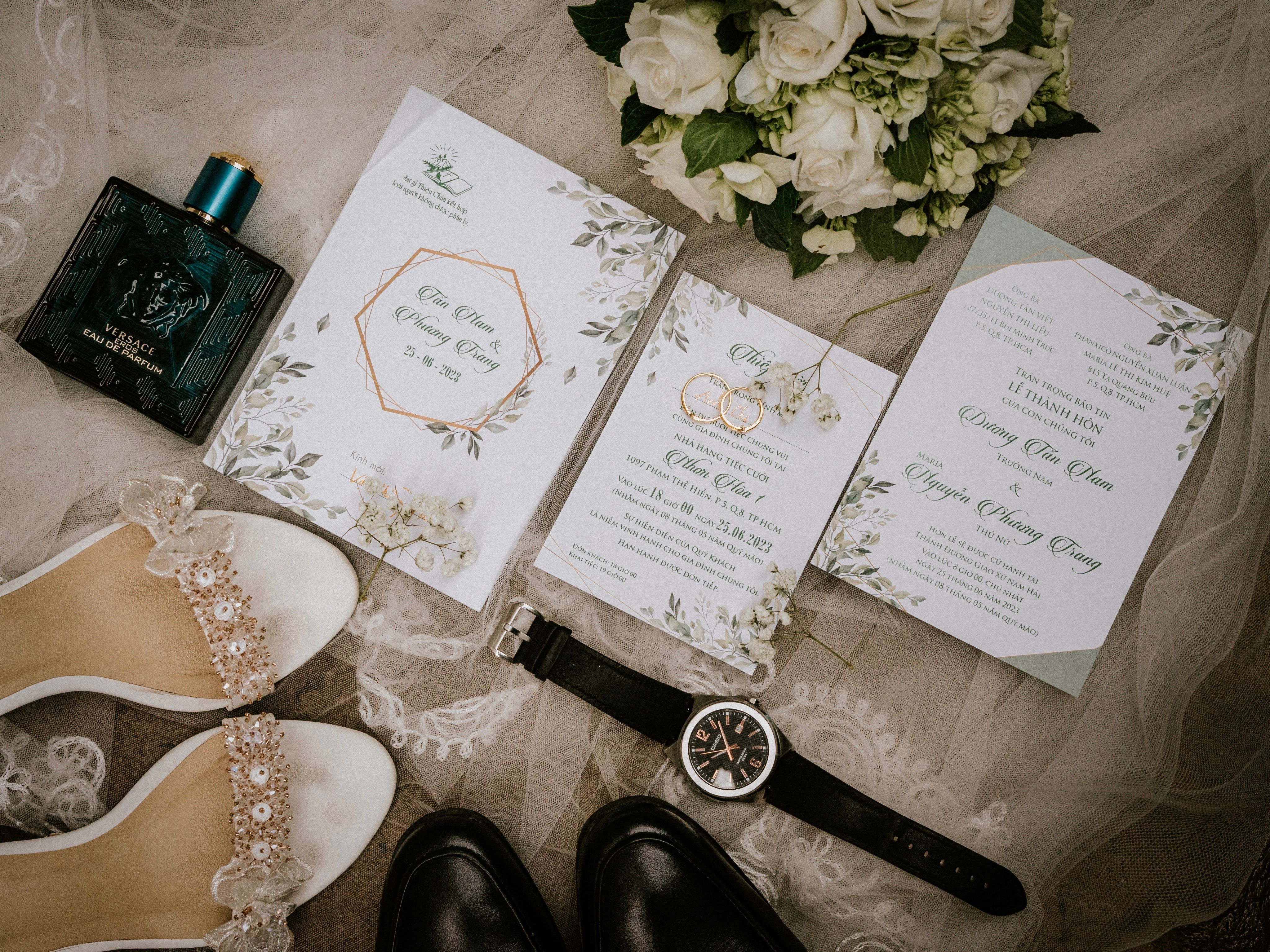
Two topics are worth anticipating. Outfits first: dress, suit, and often the same question for the maids and groomsmen, with research time, several fittings, and sometimes real assertiveness in front of a family very present on these questions. Invitations next, where tradition and digital meet. The invitation itself can stay very classic (we went with a printed A5, understated but well designed, with the wording where the parents invite you to the union of their children), but the distribution is going digital: handed over in person for close ones (a meaningful gesture, and the occasion for a real visit), sent digitally for those far away. What's systematically going digital today, whatever the invitation format, is the RSVP and the tracking of replies.
We devote a whole article to the moodboard, and another to the couple's more intimate space during the planning.
The seating plan: the last-stretch puzzle
The seating plan comes late in the project (impossible to place people until you know who's coming), but it deserves its section because it crystallises everything before it: the final list, the families, the affinities, the possible tensions, and the room layout. Add the last-minute cancellations, 10 to 15% on average, that sometimes force you to redo it all.
Two structuring pieces of advice. First, only start fine placement after replies close: any placement done before is placement to redo. You can, however, set the structure early (number of tables, capacity). Second, think by groups before thinking by individuals: families, friend groups, colleagues. Placing 100 individuals is a combinatorial nightmare; placing 12 groups then adjusting at the margin is a reasonable exercise.
And then there are all the micro-details that get forgotten: guest favours, ceremony booklets to print, place cards, directions for those coming from far. They pile up in the final weeks. Good news: they're also the ones most easily delegated, to a wedding planner or willing loved ones. The dedicated seating-plan article details the methods and the pitfalls (lone guests, blended families, children).
The Jour J: the run sheet isn't for you
Last brick, and probably the most misunderstood: the day-of run sheet. Everyone will tell you to prepare it so you can relax. The reality is different: on the day, you live the day, you don't execute it. The run sheet is for the five or six people who will run the day for you: witnesses, parents, vendors.
Which means a good run sheet has three layers: the chronology (times, places, transitions, with 15 minutes of margin between steps), the notes (weather plan B, instructions, precise sequences), and the contacts of all the vendors. On Reunion Island in particular, plan for traffic: it can seriously delay a ceremony if you've misjudged it. And above all, this run sheet must be SHARED with the people coordinating, accessible on their phone, up to date in real time. A run sheet in your head or in a file on your computer doesn't exist for those who need it.
That leaves personal preparation, which people often neglect. Not just the dress and the suit: the manicure too, including for men (they slide the ring onto your finger, the photographers will zoom in), a recent haircut, a facial if you feel like it. And above all, rest in the final days. Many couples arrive at the Jour J exhausted from running around all week. The night before our wedding was a hot bath, no screens, good books, a herbal tea, comfort food and fresh sheets prepared in advance. One of my best nights.
As a couple, or with others: the question nobody asks
Here's the topic no guide talks about, and that nonetheless explains a huge part of the planning stress: WHO does all this?
In most couples, the implicit answer is: one person. One person who keeps the file, who knows the state of the quotes, who tracks the replies, who chases the stragglers. The other helps, occasionally, when asked. This isn't anyone's fault: it's the natural slope when the planning tool is a personal file, on a personal computer, kept by whoever is most comfortable with spreadsheets. Information accumulates in one head, and with it the mental load.
The fix isn't a resolution of good will ("we'll do it together this weekend"), it's an infrastructure choice: a shared space where both see the same thing at the same time, where a guest's reply updates the list for both, where the budget's state is viewable without asking the other. Between the two first. Then beyond: your witnesses and parents will help you, and their help will be far more effective if they have access to what they need, and only that. Your witness doesn't need to see your overall budget; they need the day-of run sheet and the guest list for their mission.
Delegating without losing control is exactly what a per-section access system allows. We've devoted a whole article to it, because in our view it's the most underrated topic in all of wedding planning.
The classic mistakes (and how to avoid them)
To finish, the mistakes that come up most often in feedback from married couples.
Booking too late. Venues and good vendors go 12 to 18 months ahead. Each month of delay reduces choice and raises prices.
Underestimating the budget, or not tracking it. An optimistic forecast plus no tracking equals discovering the overspend when it's too late to arbitrate. Track the committed amount continuously.
Not planning a weather plan B, and above all not writing it down. A plan B that lives in your head isn't a plan B.
Managing everything alone, or keeping it all to yourself. The most frequent regret of married couples: not having asked for help, or having asked too late, or having spent the last week finishing everything yourself instead of enjoying it. If loved ones offer help, accept, and give them the means to be useful.
Handing too much to loved ones without a frame. The opposite exists too: delegating whole sections with no brief, no access to information, no point of contact. Help without infrastructure produces well-intentioned chaos.
Neglecting the final stretch. The last two weeks concentrate the close of replies, the seating plan, the numbers to the caterer and the day-of brief. If you reach D-15 with no system, those two weeks will be the worst of the project. With a system, they're dense but manageable.
FAQ
How long does it take to plan a wedding?
The comfortable range is 12 to 18 months, essentially dictated by the booking lead times of the most in-demand venues and vendors. You can plan a beautiful wedding in 6 months, or even less, by accepting more constraints on availability. Below 4 months, you have to be very flexible on the date, the venue and the vendors.
Where do you start when planning a wedding?
With three decisions in this order: the overall budget envelope, the order of magnitude of the guest count, then the season and type of venue. With those three frames set, the first concrete action is booking the venue, which triggers everything else.
How much does a wedding cost in France in 2026?
The average budget sits around €19,300 according to Mariages.net (study of 1,304 couples married in 2025), i.e. roughly €215 per guest for an average of 90 guests. Realistic ranges: €8,000 to €12,000 for a simple wedding, €15,000 to €20,000 for a classic wedding of 80 to 100 guests, €25,000 and up for large receptions. We break it down item by item in the dedicated article.
Do you need a wedding planner?
It's not mandatory, and most French couples do without. A wedding planner brings experience, a vendor network and time (count around 10% of the total budget). The real question is knowing what you lack: time, experience, or just structure. If it's structure, a good tool costs far less. We've written an honest article on this choice.
How do you avoid forgetting anything?
With a dated timeline, built by working back from the Jour J, and reviewed every week. The tasks of a standard wedding are known (there are proven lists, around 70 tasks for a classic wedding): the real issue isn't knowing them, it's dating them, prioritising them and tracking them together.
How do you handle planning as a couple without arguing?
By replacing informational friction points (who has the latest version? where's the budget? who has replied?) with a shared space where both see the same thing. A large part of planning tension isn't fundamental disagreement, it's coordination frustration. Infrastructure eliminates it; good will alone, rarely.
ÆTHERNA structures this whole journey: pre-filled timeline, budget tracked together, guests and RSVP online, seating plan, shared day-of run sheet. Free up to 50 guests, no time limit, no credit card. aetherna.fr
Your wedding starts here.
Start planning